
Personalized Adaptive Mountaineering Strength and Cardio Training
Why mountain athletes deserve training built for the mountains
by Jakob Ulcnik
I come from Slovenia, the only country on this beautiful rock with ‘love’ in its name. Mountains were part of my youth from the start: skiing, climbing, hiking, scrambling up limestone ridges in the Julian Alps before I was old enough to appreciate how lucky I was. Then life took a turn, and I ended up in the flattest country on earth. The Netherlands. Wind in every direction, and not a contour line in sight.
Oddly, that is where my love for mountains started burning more fiercely than ever. Distance can be funny like that. When the nearest real summit is a two hour flight away, every trip to the Alps becomes a project, and every project demands preparation. I began training seriously, not because I wanted to, but because I had to. You cannot show up to a mountain objective half-ready when there are weather windows and limited days in your annual leave.
Fast forward several seasons and a pattern had set in. Every year I trained for a new adventure in the mountains. And every year, training in an urban environment hit differently from what the mountain would actually ask. I ran. I did gym sessions. I hiked with a loaded pack on the only hill I could find, a 30m overpass, if you could call it a hill. But the real problem was not the terrain. It was the uncertainty. Training after training, I was stitching together different sources, trying to get a reading on whether I was actually ready for the summit push or not. And I never quite could.
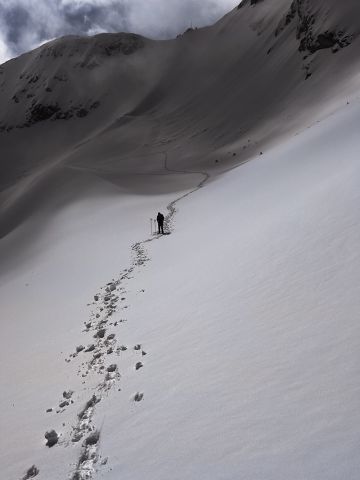
The last time it caught up with me, I was standing below the Dôme des Glaciers at 3592m in the Mont Blanc massif. The mountain is not complex by any means, not technical at all. That was not the problem. The problem was that I had been training for weeks, just not correctly. I had followed a programme that made sense on paper but not in practice. My VO2max was excellent. My heart rate zones were where the plan said they should be. But my legs were shot, and I could not point to a single metric that explained why. The tools I had were measuring the wrong things, built for a sport I was not doing.
That experience is what set me on the path I am still walking. Not because I was unfit, but because my preparation had not been designed for the mountain.
The stitched-together stack
Here is the honest picture of how most mountain athletes train today. We follow a programme from one source: a coaching service, a book, a plan downloaded from an endurance platform. We record workouts on a watch that syncs to a second platform. We log food or sleep in a third app. We paste screenshots of our training data into a group chat or a notes app, trying to make sense of whether the numbers are trending the right way. Some of us use a spreadsheet. Some of us use gut feel. Most of us use both.
Good mountain-specific coaching does exist. There are respected programmes and icons in mountaineering who are experienced coaches and who understand the demands of alpine objectives deeply. They build training around those demands, and they do it well. That is not the gap. The gap is that even with good coaching, the athlete’s daily experience is fragmented. The training plan lives in one place. The workout data lives in another. Recovery is guesswork unless you pay close attention to subjective feel or manually track heart rate variability. And none of it talks to anything else. There is no feedback loop, no system that takes what happened in Tuesday’s session, evaluates how the body responded by Thursday, and adjusts Friday’s plan accordingly.
The dominant training platforms were built to solve this problem, but they were built for road runners, cyclists, and triathletes. Their models are sophisticated, backed by decades of research, and effective for the demands they were designed to meet. But those demands are fundamentally different from what the mountain asks of the body.
Talk to any mountaineer about this and you will hear some version of the same frustration. The platform they use does not know what vertical gain is. It does not understand that a 1500m descent punishes the body differently from 1500m of ascent. It has no concept of altitude exposure, or pack load, or the cumulative fatigue of a multi-day approach. They make it work by layering their own mountain knowledge on top of a tool designed for someone else. And to their credit, many of them make it work well. But there is a question worth asking: why do we accept this?
We spend a month’s salary on a hardshell jacket to stay dry on the mountain. We obsess over gear weight down to the gram. We plan routes meticulously, study weather windows, and calculate crevasse risk. But when it comes to the training that determines whether our body is ready for the objective, we settle for tools that were not built for the job. That seems like a strange place to compromise.
What the mountain demands
Three specific gaps stand out when you compare what the mountain asks of the body with what mainstream training platforms are built to measure.
Vertical load is not horizontal load. A day involving 1500m of vertical gain and descent imposes a fundamentally different stress on the body than a day of equivalent duration on flat terrain. Going up is concentric work: the muscles shorten under load, driving the body upward against gravity. It is metabolically demanding but relatively gentle on the muscle fibres themselves. Going down is the opposite. Eccentric work means the muscles lengthen under load, acting as brakes to control each step of the descent. This braking action causes disproportionate muscular damage and extends recovery time significantly. Research in exercise physiology has shown consistently that descent-heavy days produce greater delayed-onset muscle soreness and longer recovery windows than ascent at equivalent intensities. Most training platforms treat distance and duration as the primary load drivers and ignore the vertical dimension entirely.
Altitude is not a binary. Acclimatisation is a physiological process that unfolds over days and weeks, driven by ventilatory, haematological, and cellular adaptations. It is not a switch that flips at a threshold altitude. An athlete preparing for a summit at 3700m on Aoraki/Mt Cook or 4800m on Mont Blanc needs a periodisation model that accounts for planned altitude exposure, the time course of adaptation, and the interaction between altitude stress and training load. Generic endurance plans do not have a concept of altitude in their structure. The athlete is left to layer acclimatisation on top of a plan that was not built to accommodate it.
Recovery is terrain-dependent. The recovery signature of a steep mountain day, with its high eccentric load, sustained isometric work from loaded carries, and exposure to cold and altitude, differs meaningfully from the recovery profile of a long run or a bike ride. Heart rate variability (HRV), a widely used marker of autonomic recovery status, reflects this difference. An athlete who completes a strenuous descent may show suppressed HRV for 48 to 72 hours, while an athlete who covers comparable duration on flat ground may recover in 24. Training plans that prescribe the next session based on time elapsed rather than recovery status will systematically undertrain or overtrain the mountain athlete.
The science that already exists
The good news is that exercise science has not ignored these problems. It has simply not yet packaged the answers into tools that mountain athletes can use at the daily, session-by-session level.
The conceptual foundation that matters most for understanding training adaptation is the fitness-fatigue model, first formalised by Banister and colleagues in the 1970s. The model describes training as producing two competing responses: a slowly accumulating fitness effect and a rapidly accumulating fatigue effect. Performance at any point in time is the net result of the two. When fatigue dissipates faster than fitness, the athlete improves. When fatigue accumulates without adequate recovery, performance declines despite continued training.
This is not abstract theory. It is the mathematical backbone behind periodisation, the deliberate cycling of training load and recovery that underpins modern coaching in every endurance sport. Concepts such as Chronic Training Load, a rolling average of recent training stress, and Acute Training Load, a shorter-term measure of recent fatigue, are direct descendants of Banister’s work and are used daily by coaches and athletes in running, cycling, and triathlon.
The problem for mountain athletes is that these metrics are typically calculated from data that does not capture the mountain’s signature demands. The most common input is derived from power output or heart rate relative to threshold. These measures work well on flat terrain but miss the eccentric component, the altitude penalty, and the cumulative effect of loaded vertical movement. An athlete who gains 2000m under a 12kg pack and descends the same in a single day generates a very different physiological cost from what the number on their watch suggests.
The data to close this gap already exists. Wearable devices now capture heart rate variability, sleep architecture, and daily recovery scores with reasonable accuracy. GPS and barometric sensors record vertical gain and loss with precision. Thousands of mountain athletes are collecting the right data every time they strap on a watch. What has been missing is a layer that interprets this data through a mountain lens and feeds it back into a training plan that adapts accordingly.
There is also a human dimension that the science alone does not capture but that any mountaineer will recognise. Mountain objectives are seasonal. Weather windows are unpredictable. The athlete might have eight good weekends before their target climb, and each one needs to count. A training model that understands this, that can prioritise readiness for a specific date, on a specific peak, with specific demands, is fundamentally different from one that simply accumulates fitness over time and hopes the timing works out.
Closing the loop
Adaptive training, the idea that a programme should adjust itself based on how the athlete actually responds rather than following a fixed schedule, is not new. It has been standard practice in elite coaching for decades, delivered through the human feedback loop: the athlete reports how a session felt, the coach adjusts the next block. What is new is the possibility of closing that loop with data, at a level of specificity that honours the mountain’s demands.
In the endurance world, several platforms already do this for runners and cyclists. They ingest workout data, track load accumulation, estimate recovery status, and modify upcoming sessions in response. The technology works. The fundamental science is sound. The missing piece is specificity: building models that speak the language of the mountain rather than the language of the road.
This is the problem I set out to solve when I began building Train to Mountain, an adaptive training platform designed specifically for people preparing for objectives in the 3000 to 5000m range. The platform is built on a proprietary algorithm grounded in the fitness-fatigue model, with inputs designed to reflect mountain-specific load: vertical gain and loss, terrain type, altitude exposure, and wearable-derived recovery markers. Instead of prescribing sessions based on a fixed calendar, it recalculates the training plan on a weekly cycle, adjusting intensity, volume, and modality based on the athlete’s current state and how the previous week of training actually landed.
But this is not a story about one platform. It is a story about a shift in how mountain athletes think about preparation. The principles apply whether you use software or a notebook. The core idea is the same: measure what the mountain actually demands of the body, track how the body responds, and let that information shape what comes next.
For the practical-minded, this might mean something as simple as logging vertical gain alongside duration in a training diary. Tracking how you feel 48 hours after a big descent day versus a big ascent day. Noticing that your sleep quality drops for two nights after an altitude exposure and adjusting the following week accordingly. None of this requires technology. It requires paying attention to the right variables, the ones that matter for the mountain rather than the ones that matter for a road race.
An invitation
Train to Mountain is currently entering a closed beta with a small group of athletes. We are looking for mountain climbers, alpinists, and ski tourers who want to test a different approach to preparation and who are willing to give honest feedback about what works and what does not. If you are an NZAC member preparing for an objective in the coming season and this resonates with you, I would welcome the conversation.
You can find the platform at traintomountain.com, or reach me directly at [email protected].
I think about that day on the Dôme des Glaciers often. I was not unfit. I was not underprepared in the way that word usually means. I had done the work. I had just done the wrong work, guided by the wrong model, measured by the wrong metrics. My VO2max was excellent. My legs were destroyed. The mountain did not care about my pace per kilometre. It cared whether my legs could handle the descent, whether my body could manage its oxygen at altitude, whether my recovery from the previous weeks had left me ready or merely not broken.
We do not settle for a jacket that is almost waterproof. We should not settle for training that is almost relevant. The mountains grade on readiness, not effort. It is time we trained accordingly.