Arc'teryx 30L Pack Comparison
By Graham Johnson
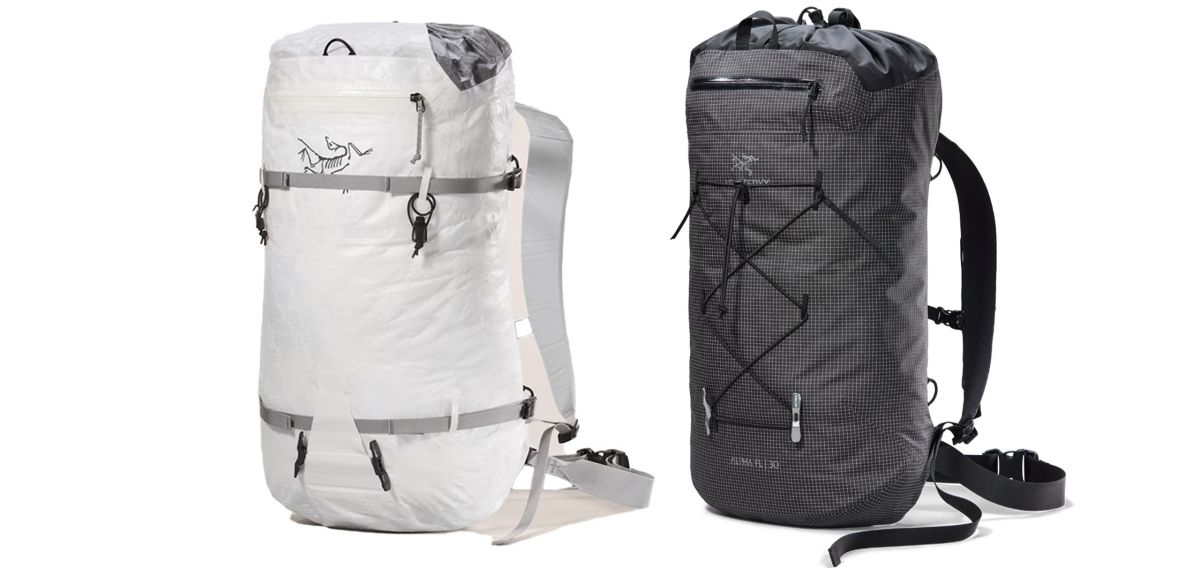
Arc'teryx Alpha SL 30 (left) vs Alpha FL 30 (right)
One of my guilty pleasures is flipping through old climbing magazines. One of my other guilty pleasures is buying backpacks. I was recently looking at an article from 2003 in Climbing Magazine (USA) about a round-up of ‘fast and light alpine packs’. All of the packs they looked at were between 50 and 65L—huge by today's standards and the lightest pack was over 1kg, with the heaviest at 1.8kg. About 10 years ago I did a round-up of alpine packs for The Climber and my criteria were 30-40L and had to be less than 900g stripped. How times have changed for the lighter and smaller. These days, unless it's a multi-day alpine route or I’m needing to carry an extra pair of boots, I'm generally carrying something in the 30L range in the mountains.
Earlier in 2025, Arc’teryx released a new addition to their Alpha series of climbing packs—the Alpha SL 30. There is already a 30L pack in the lineup—the Alpha FL 30. The big question for any potential customer is: which one do I get? While it might be easy to look at the SL and say it's just a FL in a lighter package with a new fabric, there's a little bit more to it. I never need much of an excuse to buy a new backpack, but a comparison review of the FL and the SL seemed the perfect reason!
Weight and materials are the two biggest differentiators between these two packs. The SL weighs in at 444g fully kitted out, or 316g fully stripped (all weights are per Arc’teryx) while the FL doesn't really have anything to strip and weighs in at 648g. While the dimensions listed on the website are slightly different for each, the stated volume is the same and they seem to be exactly the same size (without extending the FL's interior collar).
The SL is made of a dyneema-type fabric called Graflyte—a multi-layer laminate that is both super light, strong and durable (claimed). 200 denier in the body and 50 denier in the collar. It feels like a bulletproof rubbish bag,
A hot take on packs—I've had many backpacks over the years and I can count on one hand the number of packs that have not been durable enough for many years of abuse. ‘Extra Durability’ as a selling feature is overrated.
My FL is still brand-new looking despite a few years of use. The fabric on the FL is also a laminate—315 denier AC2 in the body and a 70 denier nylon on the roll-top extension collar. It is much thicker, having some stiffness on its own that the Graflyte does not have. The FL feels more robust than the SL and the difference in materials is where much of the weight savings comes from. The FL has a weirdly smooth material and I like the white lining which makes it easy to see everything in an otherwise black pack (the FL comes in many colours but always a white interior). The SL only comes in white and is quite translucent. Still very easy to see stuff inside and sometimes from the outside!
Straps—both packs have a top strap for a rope or just compressing the top of the pack. Annoyingly, the top strap for the SL is significantly shorter than that for the FL, limiting the ability of the SL to be overstuffed and still have a strap to secure it all. There are no included side straps on the FL, but the SL has two side straps that wrap all the way around the front of the pack. The SL also has a removable waistbelt, while the FL's is sewn into the pack. All of the straps connect with Arc’teryx’s now standard, but still annoying, loop-and hook closure which are prone to popping off unless tensioned. Another annoying thing is that it seems that every model of Arc’teryx pack has a variation on this, so it's hard to swap straps between packs. As soon as I took the SL out of the box, I removed the side straps and haven't touched them since.
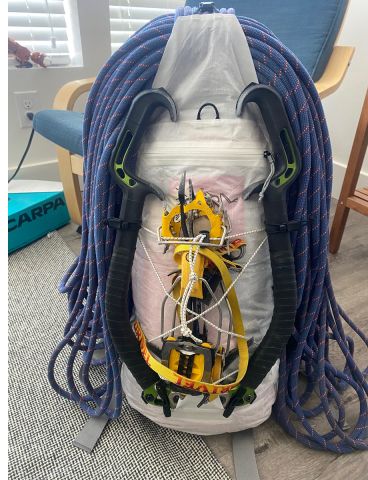
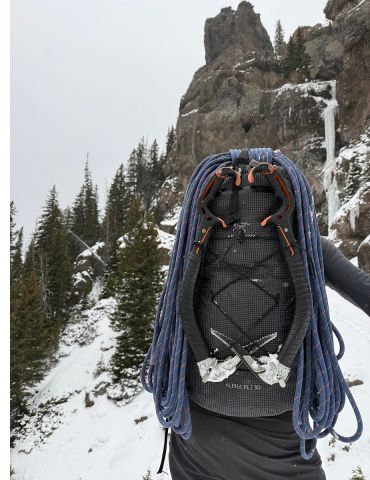
The FL comes supplied with a do-it-all bungee that carries tools, extra layers, crampons, whatever. There are loops to attach straps (I prefer Voile ski straps), but I hardly ever do this. The SL has two fewer loops on the front, but I have rigged a similar bungee system to the FL. It's not quite as secure as the FL, given that it has only one cross point vs. two, but it works fine. The FL has the standard metal ice tool toggles while the SL replaces them with a plastic version. Time will tell whether this was the right call. The SL has its own dedicated tool handle bungees that are slightly more difficult than necessary to use with gloves on, but it works.
Pockets—both packs have two pockets—one water-resistant pocket in the front of the pack and one inside. With the FL, the pocket is on the interior collar and is quite difficult to use unless the collar is up. If I use this pocket, it's for something like car keys that I won't be touching until the trip is over. On the SL, the second pocket is hanging inside and is much easier to use—a better design. For both packs the front pocket is difficult to access if the pack is full or you are carrying tools. Not really a pocket but the SL does have a slot to keep ice tool picks from flopping around. A nice but not necessary touch.
Comfort and climbing ability. I honestly don't notice a huge difference between the two in use. Both allow for excellent mobility, no issues with hitting your helmet when looking up. Both have the same stiff foam on the inside to provide some structure and a smooth, non-snow-collecting back panel. It shouldn't come as a surprise that these lightweight packs with webbing hip belts and no load lifters are not great for carrying heavy loads. But for the loads they're expected to carry—a rack, rope, supplies for a day+ mission, they do fine. The moderately observant reader will notice I've attached some hip pads (from Exped) to the webbing hip belt on my FL—these are great and make the hip belt much more comfortable. I now transfer them between the packs as needed.
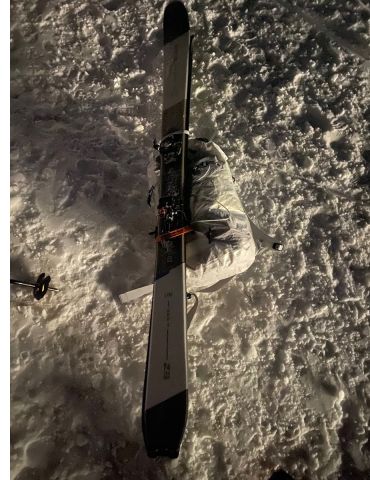
Skiing—this is always my bugbear with Arc'teryx packs—they can make a good climbing pack OR a good ski pack, not one pack that does both. The biggest part of this is carrying skis on your pack—of course you can ski with any old sack- and both packs are fine for that—but neither is out of the box ready to carry skis. Both can accommodate straps to carry skis, but the SL is especially poor at it. There's just not enough structure to the packs to carry such unwieldy items without them flopping around. On a recent trip to Chamonix, a significant number of people were using the FL with some attachments to carry skis—a loop at the bottom and then using the rope strap to secure them at the top. Still not a ski pack, but works fine.
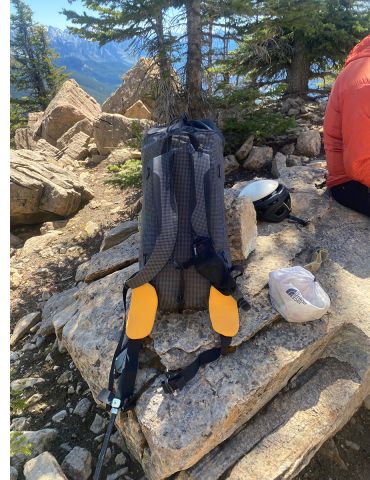
Annoying things about the SL—these are mostly small niggles that should have been corrected in the testing phase. Where the FL feels super dialed in, the SL still feels...unrefined. The switch to plastic ice tool toggles—It just feels cheap and fragile for a premium product and maybe only a gram or two lighter. The rope strap—this is much shorter than the FL and due to the design, it pulls towards your head, which means that any excess is prone to slipping down your back and being irritating vs. pulling away and dangling down the front of the pack. The other annoying thing about this design is that when carrying skis diagonally (I don't like A-framing) the buckle is right against the ski and can break or pop off—unlike the ‘Pull away from the head’ design of the FL where only the webbing contacts the ski. The SL has a little ‘flap’ of fabric that allows for two different connection points with the rope strap. Ostensibly this is to cover the opening of the pack, but it really just kind of bunches up when you are using the lower loop. When fully loaded up, the rope strap is just barely long enough to carry a rope. No interior collar means that rain/snow can get in and you can't over stuff it.
SL 3.5/5—This is a decent pack. But it could have easily been better and the only metric the SL has over the FL is weight. I would only purchase this if you want one of the lightest 30L packs out there and have an excess of cash. If anyone at Arc’teryx is listening (I know they aren't, but I'm going to shout into the wind anyway)—this should have been a 35L pack with broadly the same design as the rest of the FL. That way it wouldn't compete directly with the FL 30, be clearly focused for bigger objectives, but still small enough that one would still use it in the same situations where a 30L pack would be appropriate.
FL 5/5—Buy this one. Okay, it's almost double the weight, but it's by no means a heavy pack. It climbs great and will last you for many years at the least. And you have the option to be very weatherproof with the roll top, or over stuff the pack a little—unlike the SL. There's a reason this has been virtually unchanged for almost 10 years. Every time I used this pack (which is often) I am reminded of how much I like it. My only regret with this pack is not buying one sooner.